How to Spot Fake Wagyu: A Buyer's Guide to Japan's Premium Beef
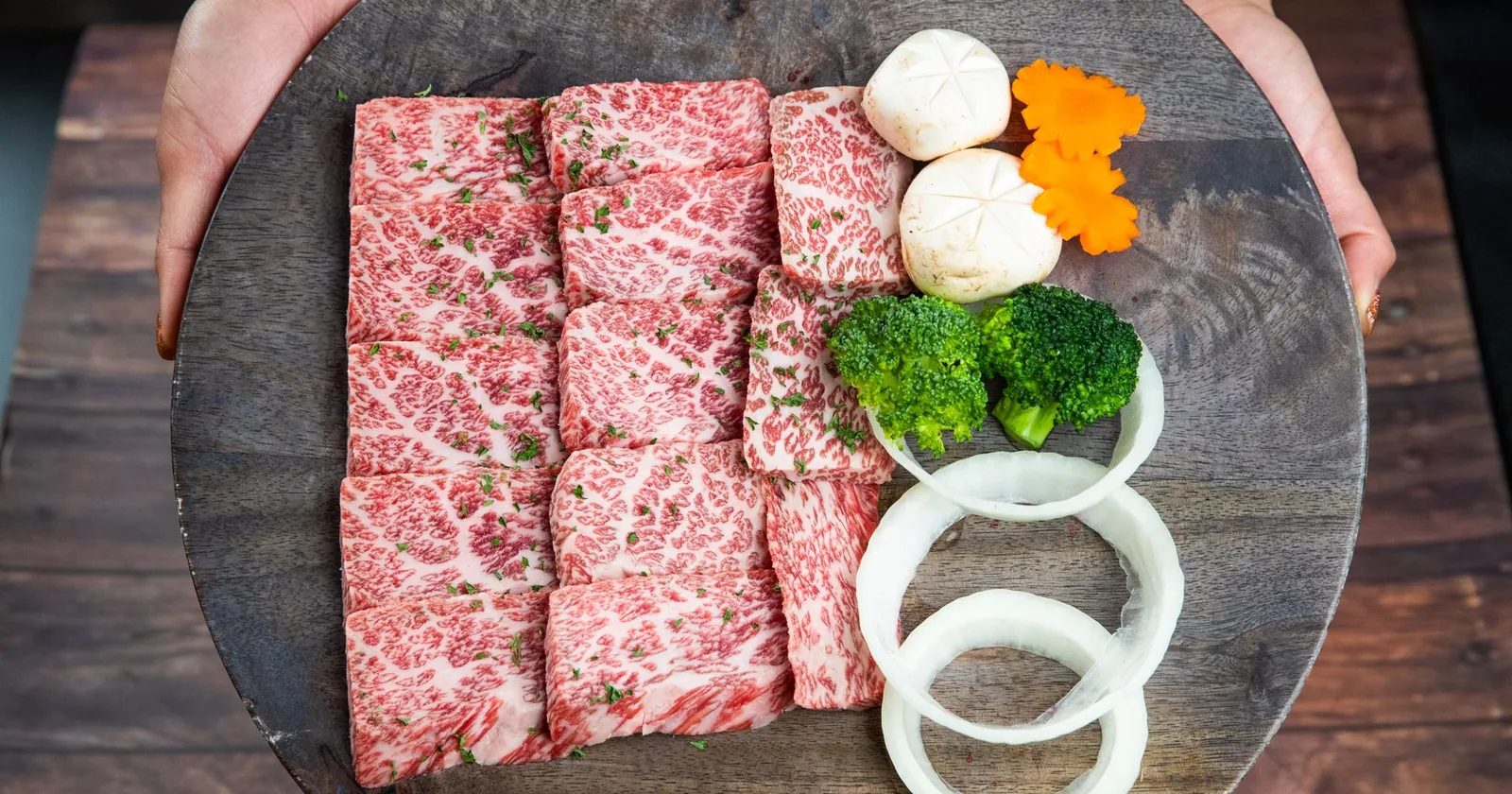
The word wagyu now appears on airport smash burgers, on supermarket meatballs, on hot dogs, and on steakhouse menus at prices that ought to raise an eyebrow in both directions. Some of those labels are perfectly honest. Others are a word doing marketing work it was never built to do. The encouraging part is that Japan runs what is probably the most rigorous cattle traceability system in the world, and it produces documents and numbers that you, standing at a counter, can actually check. You do not need to be able to read marbling like a grader. You need to know which four or five questions have verifiable answers.
Wagyu Is a Breed Word, Not a Quality Word
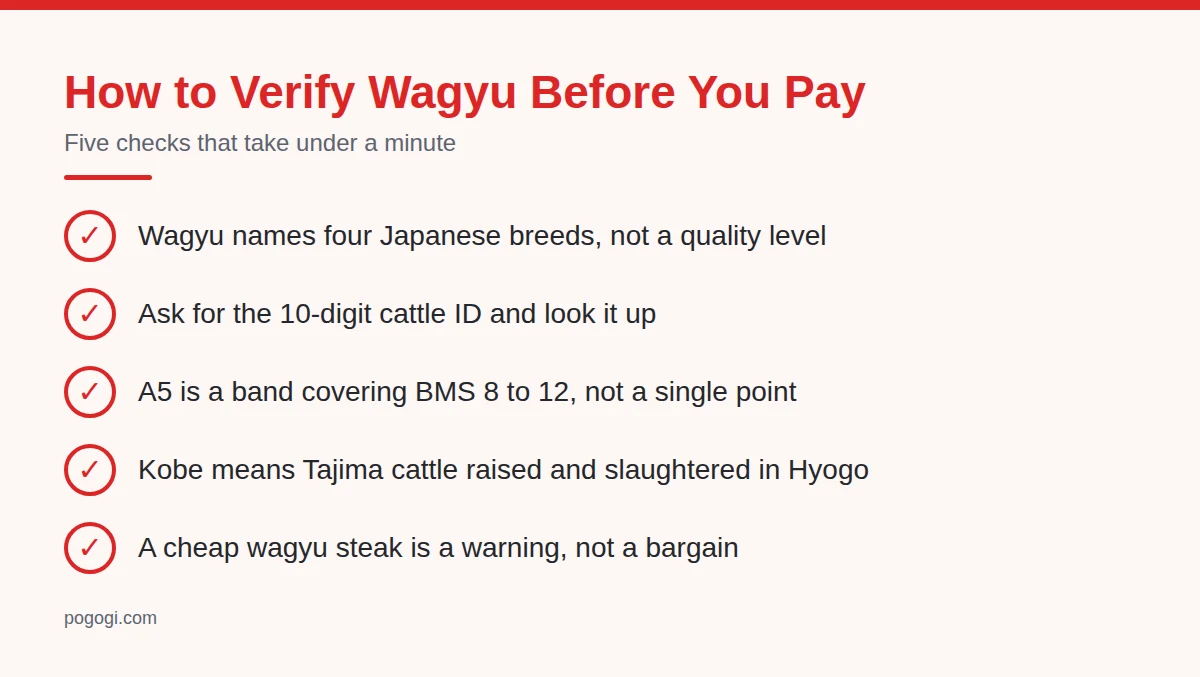
Wagyu simply means Japanese cattle: wa for Japanese, gyu for cattle. It is a category of breeds, not a grade, not a region, and not a promise about how anything tastes. Japan recognises exactly four:
| Breed | Japanese name | Share of the Japanese herd |
|---|---|---|
| Japanese Black | Kuroge Washu | Roughly 95 percent, and the source of nearly all famous branded beef |
| Japanese Brown | Akage Washu (also Akaushi) | A small minority, mostly Kumamoto and Kochi |
| Japanese Shorthorn | Nihon Tankaku Washu | Under one percent, mostly northern Japan |
| Japanese Polled | Mukaku Washu | The rarest of the four, centred on Yamaguchi |
The intense marbling everyone associates with the word is really a Japanese Black trait. The other three are leaner, beefier animals with their own following in Japan, and the Shorthorn in particular is prized for flavour rather than fat.
For beef leaving Japan, the Japan Livestock Products Export Promotion Council administers the Universal Wagyu Mark, and its requirement is blunt: purebreds or crosses of those four breeds, born and raised in Japan, verified through the national traceability system. Genetics alone are not enough. Origin is part of the definition.
Outside Japan, no comparable rule attaches to the word. In the United States the only federal specification in the neighbourhood is USDA Schedule GLW, approved in February 2014, which governs branded beef programs that claim “Wagyu influence.” It requires the animal to be traceable to at least one registered Fullblood or Purebred parent of at least 93.75 percent wagyu blood. Read that carefully: the parent must be nearly pure, which means the animal on your plate can be a 50 percent first-generation cross and still qualify for the claim. And a restaurant menu is not a branded beef program. Nothing at all governs the word wagyu written on a chalkboard.
The 10-Digit Number That Settles the Origin Question
Every bovine born in Japan is ear-tagged at birth with a 10-digit individual identification number. This is not an industry courtesy scheme. It is required under the Act on Special Measures Concerning Management and Relay of Information for Individual Identification of Cattle, introduced after the BSE crisis, and it applies to every animal in the country.
That number resolves in a public database run by the National Livestock Breeding Center. Type it in and you get the animal’s date of birth, sex, breed category, every farm it passed through, and where and when it was slaughtered. Alongside it, each calf is issued a registration certificate that records its nose print, the muzzle pattern being as individual as a fingerprint. Newer exports increasingly carry a QR code that pulls up the same pedigree.
The practical consequence is the single most useful thing in this article. A genuine Japanese wagyu seller can give you the number. Butchers and restaurants in Japan display it as a matter of routine, and serious importers pass it along. If a shop is selling something as Japanese A5 and cannot produce a 10-digit ID that resolves in the database, the origin claim is unverifiable, whatever is printed on the label.
American or Australian wagyu will never have one, and that is not fraud. It is simply not Japanese beef, and it is sold legitimately every day. The fraud is charging Japanese prices for it.
What A5 Actually Means, and What It Doesn’t
Carcasses in Japan are graded by the Japan Meat Grading Association on two axes, giving fifteen possible combinations from C1 to A5.
| Element | Scale | What it measures |
|---|---|---|
| Yield grade | A, B, C | How much saleable meat the carcass yields, A being the highest |
| Quality grade | 1 to 5 | The lowest score among four separate quality factors |
| Marbling (BMS) | 1 to 12 | Amount and fineness of intramuscular fat, one of the four factors |
Two things follow that most menus quietly ignore. First, the quality number is set by the worst of the four factors, which are marbling, meat colour and brightness, firmness and texture, and fat colour and lustre. A carcass with spectacular marbling and mediocre fat colour does not get a 5. Second, quality grade 5 covers everything from BMS 8 up to BMS 12. A5 is a band, not a point. A BMS 8 steak and a BMS 12 steak are both truthfully A5 and should not cost the same.
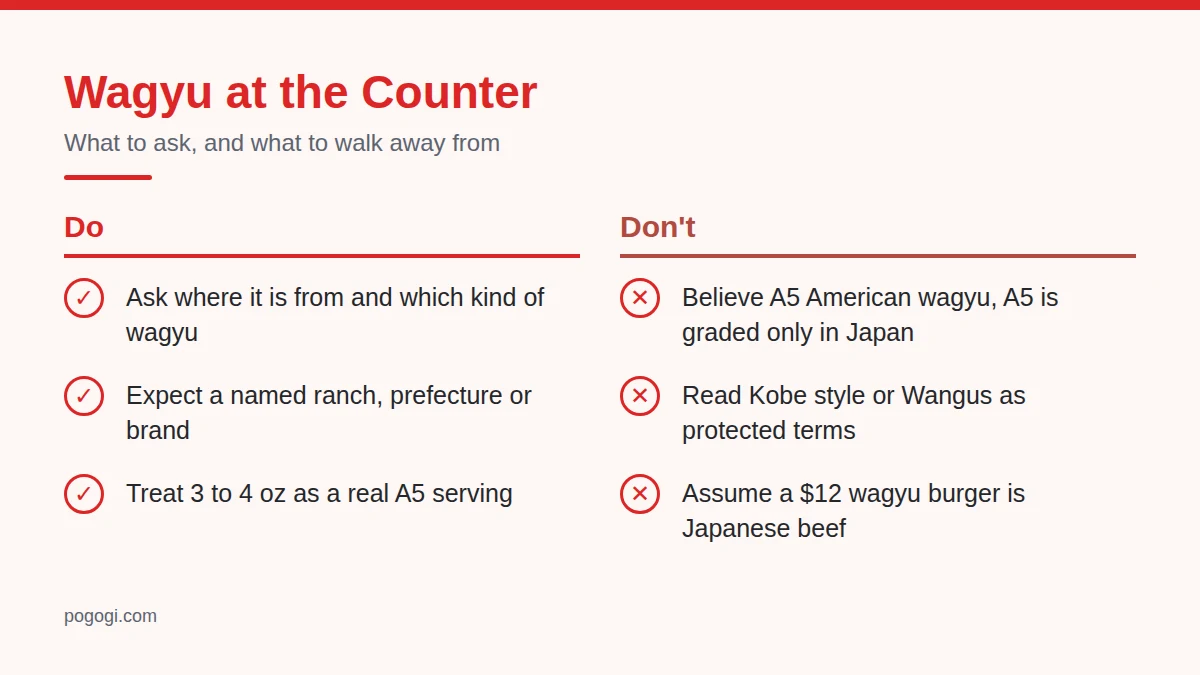
This also gives you a clean red flag. JMGA grades carcasses in Japan. There is no mechanism by which it grades an animal raised in Texas or Queensland. Australia uses the AUS-MEAT marble score, which runs 0 to 9+, and the United States uses USDA Prime and Choice. “A5 American wagyu” is a category error, and when you see it, someone is either careless or counting on you not knowing.
Kobe Beef Is the Narrowest Claim of All
Most beef sold as Kobe outside Japan is not Kobe. The real thing is a geographical indication registered with Japan’s Ministry of Agriculture, Forestry and Fisheries as GI No. 3, sitting alongside Matsusaka beef at No. 25 and Yonezawa beef at No. 26. The criteria set by the Kobe Beef Marketing and Distribution Promotion Association are unusually specific:
- Tajima lineage cattle, born at designated breeding farms in Hyogo Prefecture and raised entirely within it
- A steer or a heifer that has never calved
- Slaughtered at an approved facility in Hyogo, typically at 28 months or older and averaging 32
- BMS of 6 or higher
- Yield grade A or B
- Gross carcass weight of 499.9 kg or less
- Fine texture and firmness
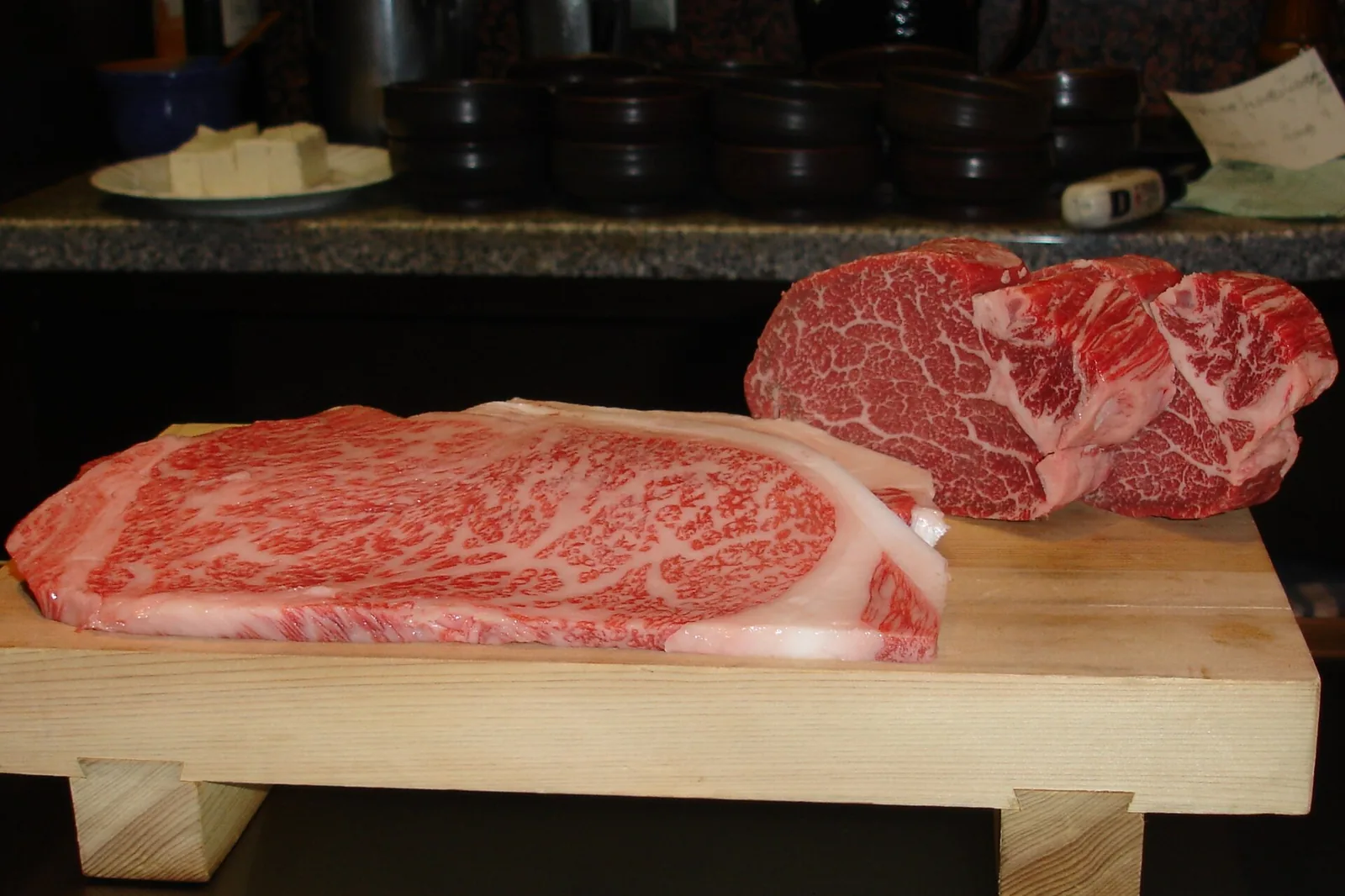
The volume tells you the rest. Around 7,000 Tajima cattle go to market each year and only about 5,500 of them clear certification as Kobe beef. Certified carcasses carry a stamped Japanese chrysanthemum mark, designated retailers display a bronze Tajima cattle statuette, and the 10-digit ID goes on show in the shop. Export began only in February 2012, to Macao, and the association still publishes its list of authorised overseas outlets.
So when a pub advertises Kobe sliders, no fraud investigation is required. Ground Kobe beef, sold at slider prices, from a restaurant not on that list, is a claim about style. For the real story of how the Tajima line became what it is, see our longer piece on Kobe beef, and if the region itself is on your itinerary there is more in 5 things to experience in Kobe.
Red Flags at the Counter and on the Menu
| What you see | What it usually means |
|---|---|
| A 16 oz “American wagyu” steak at $49 | Chef Jesse Schenker’s rule of thumb is that this should be nearer $79. Too cheap is a warning, not a bargain |
| A 12 oz portion of A5 | Real A5 is served in small portions because it is too rich to eat by the slab |
| ”Kobe style”, “wagyu style”, “Wangus” | Marketing language. None of these are protected or defined |
| A5 with no prefecture, farm or brand named | Japanese sellers name the region. Vagueness at this price point is a choice |
| No 10-digit ID available on request | The origin claim cannot be checked |
| Wagyu on a $12 burger | Possibly a legitimate small percentage of wagyu genetics, at a fair price. Just do not read it as Japanese beef |
Evan Carter of The Meat Dudes reduces the whole exercise to two questions worth asking out loud: where is it from, and what kind of wagyu is it. If the answer names a ranch or a prefecture, you are probably in good hands. If it is a shrug, you have your answer too.
American Wagyu Is Not Fake Wagyu
It is worth separating mislabelling from the product itself. American wagyu is a real category with real pedigree behind it, descended from a small number of Japanese cattle exported decades ago, before Japan closed that door for good. In 2020 the country amended its Livestock Improvement and Propagation Act and passed a companion law on livestock genetic resources, making unauthorised export of wagyu semen and embryos a criminal matter after a 2018 attempt to smuggle fertilised eggs to China. A senior ministry official described wagyu as a national asset, which is close to the literal legal position now.
As Stephanie Hamilton of JBS Imports puts it, most wagyu available in the United States reflects Japanese genetics rather than Japanese origin, usually crossed with domestic cattle and finished for a flavour profile Americans already like. That is a perfectly good steak. It is a different steak. Our older comparison of American and Japanese wagyu walks through how the two eat differently, and if you want a third example of how tightly Japanese branded beef is tied to place, Hida beef in Takayama makes the point neatly.
Once You Have Verified It, Eat It Properly
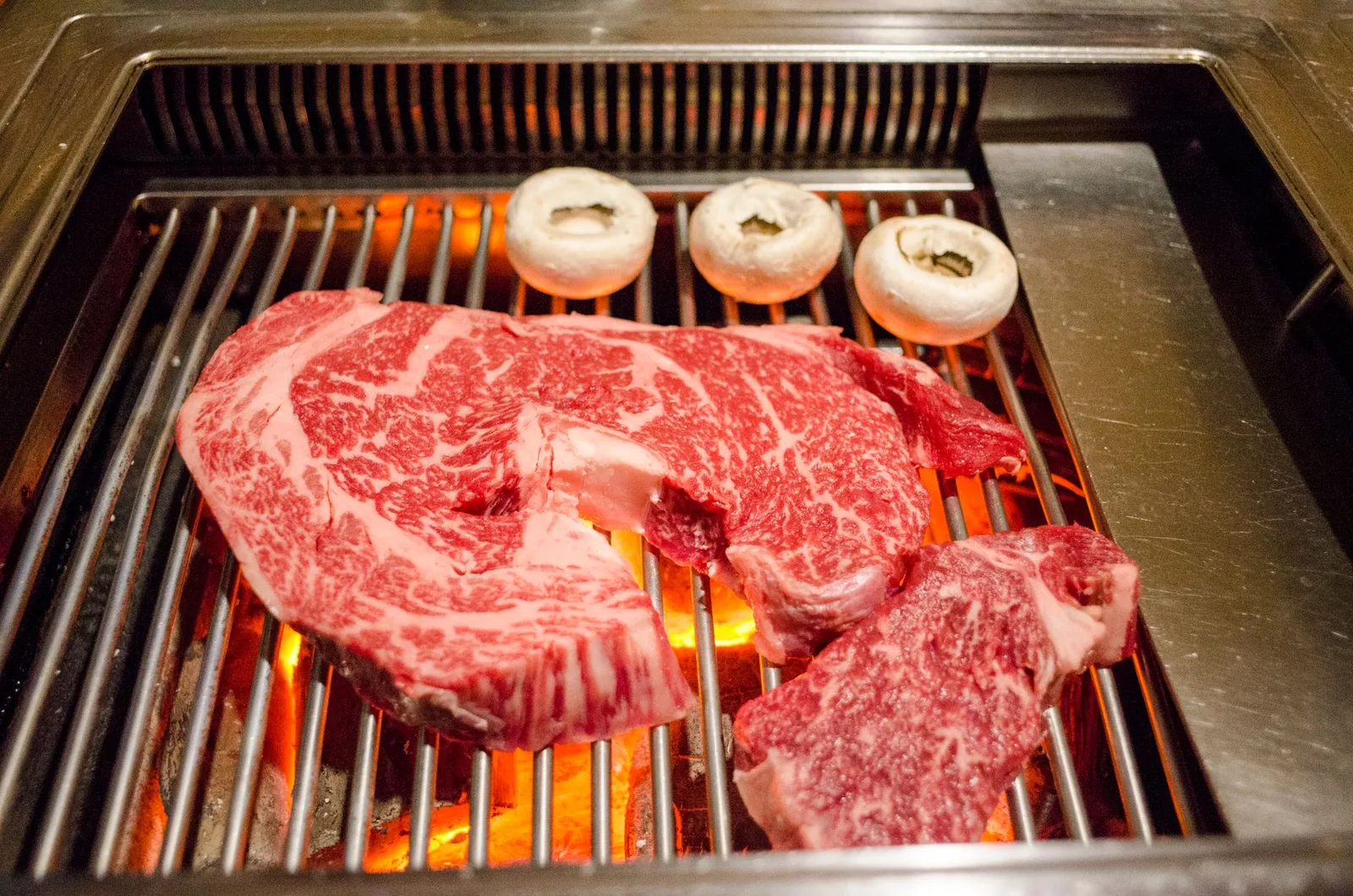
Verification is only half the value. Highly marbled wagyu is designed around small portions and high-heat, short-contact cooking, which is exactly why Japan eats it in paper-thin slices rather than as a steak. Sukiyaki and shabu shabu both exist because a little of this beef, cooked for seconds, goes further than a lot of it seared hard. Three to four ounces of A5 is a serving. If a restaurant is bringing you a half-pound of it, that is worth as much scrutiny as the price.
References
- Fox News · industry experts on how loosely the wagyu label is used and the price cues that give it away
- Japan Livestock Products Export Promotion Council · the Universal Wagyu Mark and the four recognised Wagyu breeds
- Japan Livestock Products Export Promotion Council · the 10-digit individual identification number and Japan’s cattle traceability system
- National Livestock Breeding Center · the public database where a 10-digit cattle ID can be looked up
- Kobe Beef Marketing & Distribution Promotion Association · the official Kobe Beef certification criteria
- Kobe Beef Marketing & Distribution Promotion Association · how many cattle are certified each year and how buyers verify a shop
- Ministry of Agriculture, Forestry and Fisheries · Kobe Beef as geographical indication registration No. 3
- USDA Agricultural Marketing Service · Schedule GLW, the specification for cattle eligible for branded beef programs claiming Wagyu influence
- Australian Wagyu Association · the AUS-MEAT marble score of 0 to 9+ used outside Japan
- Kyodo News · Japan’s move to criminalise unauthorised export of wagyu genetic material