What Is Onigiri? Japan's Rice Ball Explained: Shapes, Fillings and Why It Isn't Sushi
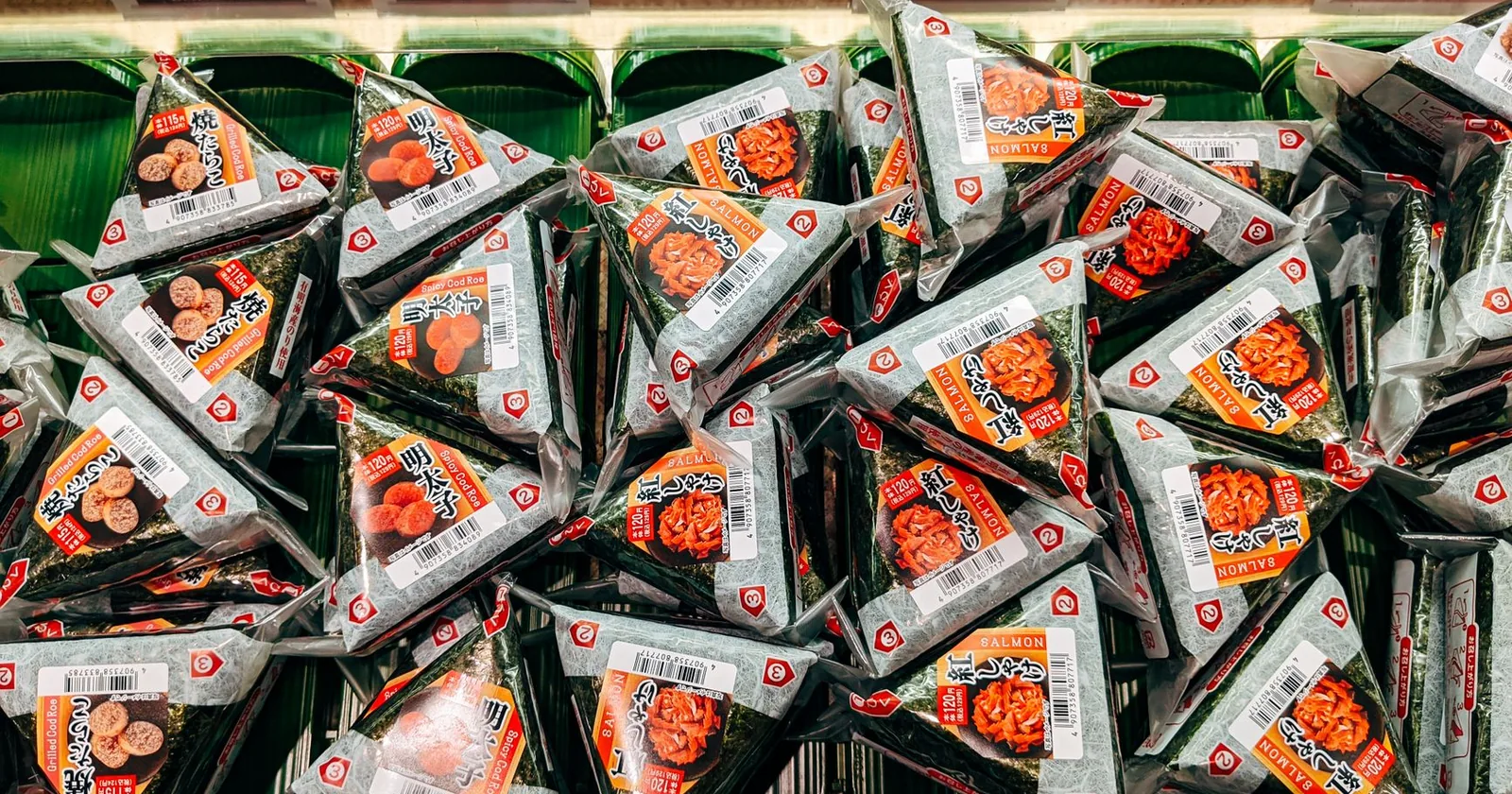
Walk into any convenience store in Japan and one shelf will be busier than the rest. It holds triangles: rice, wrapped in film, stacked by the dozen, each one labeled with what is buried in the middle. People buy them on the way to work, on the way to a train, on the way up a mountain. Nobody thinks of it as remarkable food. It is simply what you eat.
That shelf is onigiri (おにぎり), and it is arguably the most important thing in Japanese cooking that nobody outside Japan takes seriously enough. It predates sushi. It predates the country’s written history. And it is now, improbably, a growth category on international supermarket shelves: one market study values the global instant onigiri trade at roughly US$1.06 billion in 2025 and projects US$1.67 billion by 2033, with Asia-Pacific holding about 45 percent of it. A two-thousand-year-old field lunch has become an export.
Here is what onigiri actually is, how it is made, and the distinction that trips up almost every newcomer.
What Is Onigiri?
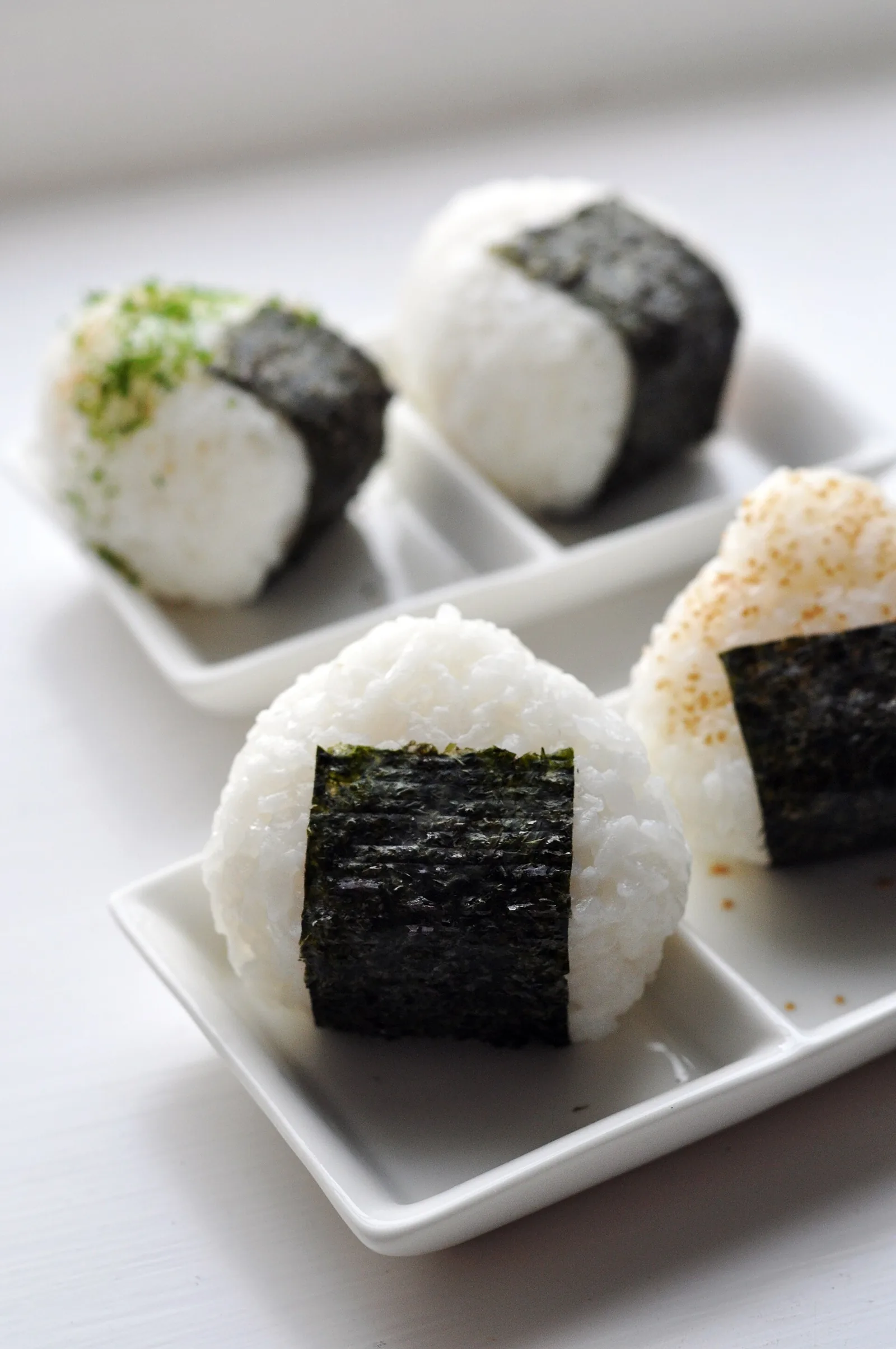
Onigiri is cooked Japanese short-grain rice, lightly salted, pressed by hand into a shape that holds together, usually with something savory hidden in the center and often with a band of nori seaweed around it. That is the whole definition. It is also called omusubi (おむすび), and Japanese speakers will tell you the two words mean the same thing while quietly disagreeing about which is more polite, more regional, or more old-fashioned. Both are correct.
The word comes from nigiru, to grasp or press with the hand. The eighth-century regional gazetteer Hitachi no Kuni Fudoki already refers to hand-formed rice as nigiri ii. What makes onigiri work is the rice itself: Japanese short-grain japonica is starchy enough that pressed grains cling to each other without any binder. Long-grain rice physically cannot do this, which is why substituting basmati produces a sad pile rather than a rice ball. If you want the background on the grain, our guide to Japanese rice and its uses covers the varieties, and how to cook rice and why people wash it first covers the step that decides whether your onigiri holds.
Onigiri Is Not Sushi
This is the single most useful thing to know, and it comes down to one ingredient.
Sushi is defined by vinegared rice. The word refers to shari, rice seasoned with rice vinegar, sugar and salt. The fish is optional; the vinegar is not. Onigiri rice has no vinegar at all. It is plain steamed rice with salt, and that is the entire seasoning.
The second difference follows from the first. Because vinegared rice is mildly acidic and was historically a preservation method, sushi can carry raw fish. Onigiri fillings are cooked, cured, salted or pickled: grilled salmon, simmered kelp, pickled plum, canned tuna. You will not find raw fish in a traditional onigiri, and you should be suspicious of one that claims otherwise. If the sushi side of the family interests you, we untangle the related confusion in sushi vs sashimi.
Call an onigiri a “sushi rice ball” in Japan and you will be gently corrected. They are cousins, not the same dish.
The Three Shapes
Shape is not decoration. It is regional history, and each form has a logic.
Sankaku (三角), the triangle. The dominant shape today and the one every convenience store uses. The flat faces stack efficiently, the wide base sits stable in a lunchbox, and the three corners give you somewhere to bite that is not the filling. One traditional reading connects the shape to mountains, since food offered to kami was often given a mountain silhouette.
Tawara (俵), the drum. A short cylinder with flat ends, named for a straw rice bale. This is the Kyoto and Osaka form, and it is the shape you still see in makunouchi bento boxes, where flat ends pack tightly in a row. It is the most formal-looking of the three.
Marui (丸い), the round. The simplest and oldest instinct, common in eastern Japan and in home kitchens where nobody is trying to impress anyone. Ball-shaped onigiri travel well in a cloth and take about four seconds to form.
Edo-period records show round and triangular versions in the east while the Kansai region favored the bale. The convenience store industry effectively settled the argument in favor of the triangle, for reasons that have more to do with packaging machinery than with tradition.
Salted Hands, Warm Rice, Light Pressure
The technique is simple and easy to get wrong. Three things matter.
Salt goes on your hands, not in the rice. The traditional method is te-shio: wet your palms with water (tezu), rub a pinch of salt between them, then form the ball. The salt lands on the outside where you taste it first and where it does the most preserving work. Mixing salt through the rice gives you uniformly salty rice and a duller bite.
The rice must be warm, not hot and not cold. Freshly cooked rice, rested to roughly body temperature, presses cleanly. Cold rice from the refrigerator will not bind, because the starch has already retrograded and hardened.
Press firmly enough to hold, lightly enough to keep air. Three or four rotating presses is the standard, turning the ball a third each time. A compacted onigiri is dense and gluey; a properly made one holds its shape until you bite it and then falls apart in your mouth. This is the part that takes practice, and it is why a good onigiri-ya counter is worth the queue.
The Classic Fillings
The traditional fillings share a common trait: they are salty, strongly flavored, and keep without refrigeration. This is not an accident. Onigiri was field food, travel food and soldiers’ food long before it was snack food.
| Filling | Japanese | What it is |
|---|---|---|
| Pickled plum | umeboshi | Salt-cured ume fruit, intensely sour and salty. The oldest and most iconic filling. |
| Salted salmon | shiozake / sake | Salted and grilled salmon, flaked. The most popular filling in Japan by most surveys. |
| Bonito flakes | okaka | Katsuobushi tossed with soy sauce. Deeply savory, and the cheapest thing in the case. |
| Simmered kelp | kombu tsukudani | Kombu slow-cooked in soy sauce and mirin until dark and sweet-salty. |
| Cod roe | tarako / mentaiko | Salted pollock roe, plain or chili-marinated. A Fukuoka signature. |
| Tuna mayonnaise | tsuna mayo | Canned tuna and Japanese mayonnaise. A 1983 convenience store invention that became a national staple. |
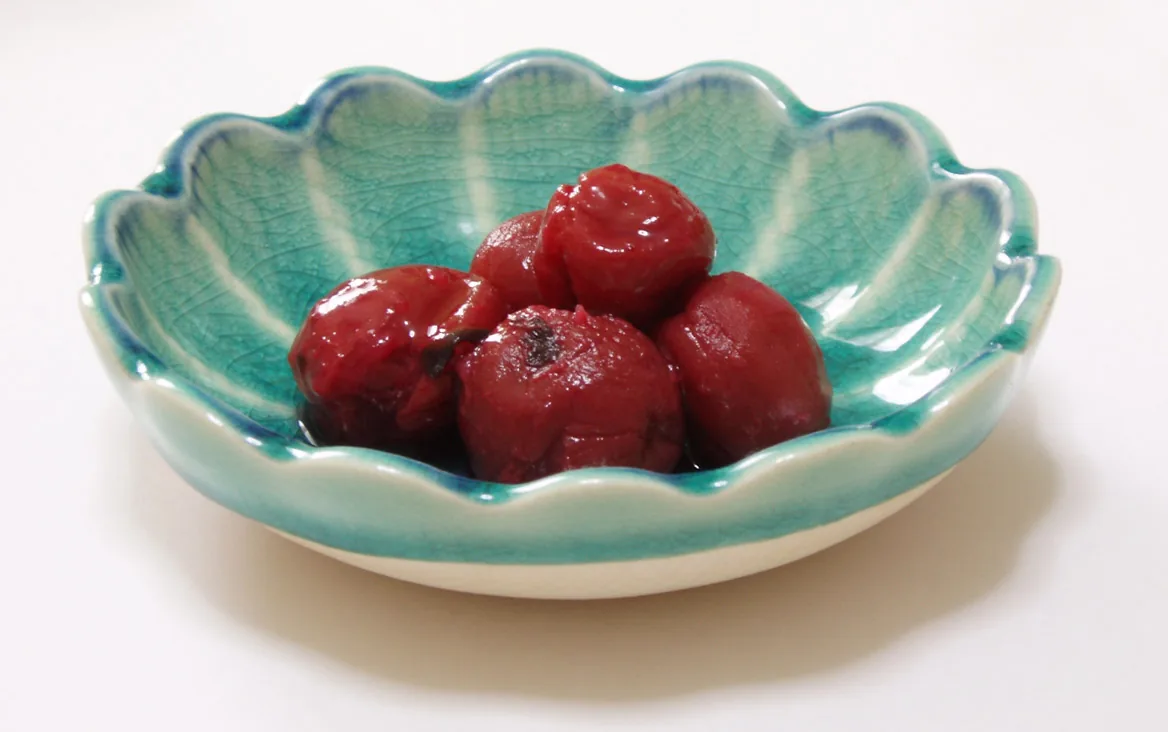
Umeboshi deserves its own note. It is not a plum but a salt-cured ume, closer to an apricot, and it is powerfully antimicrobial. A single umeboshi in the center of a rice ball helped keep a lunch edible through a hot working day, centuries before anyone owned a refrigerator. That utility produced the hinomaru bento: a box of plain white rice with one red umeboshi dead center, a lunch that looks exactly like the Japanese flag. It sits alongside the rest of Japan’s preserving tradition, which we cover in tsukemono, Japanese preserved vegetables.
The Nori Problem, and the Wrapper That Solved It
Nori goes around an onigiri for grip and for flavor, and it presents an engineering problem: seaweed pressed against damp rice turns limp within an hour or two. Home cooks solve this by carrying the nori separately and wrapping at the last moment.
In 1978, Seven-Eleven Japan solved it commercially with a wrapper that keeps a sheet of nori sealed in its own layer of film between the seaweed and the rice. Pull the tab, the film slides out, and the nori meets the rice crisp for the first time at the moment you eat it. A cut-tape refinement followed in 1986, and that pull-tab design is now on hundreds of millions of rice balls a year. It is one of the genuinely great pieces of food packaging, and it is the reason convenience store onigiri is good rather than merely convenient. For more on the seaweed itself, see dried seaweed (nori).
Yaki Onigiri and Other Variations
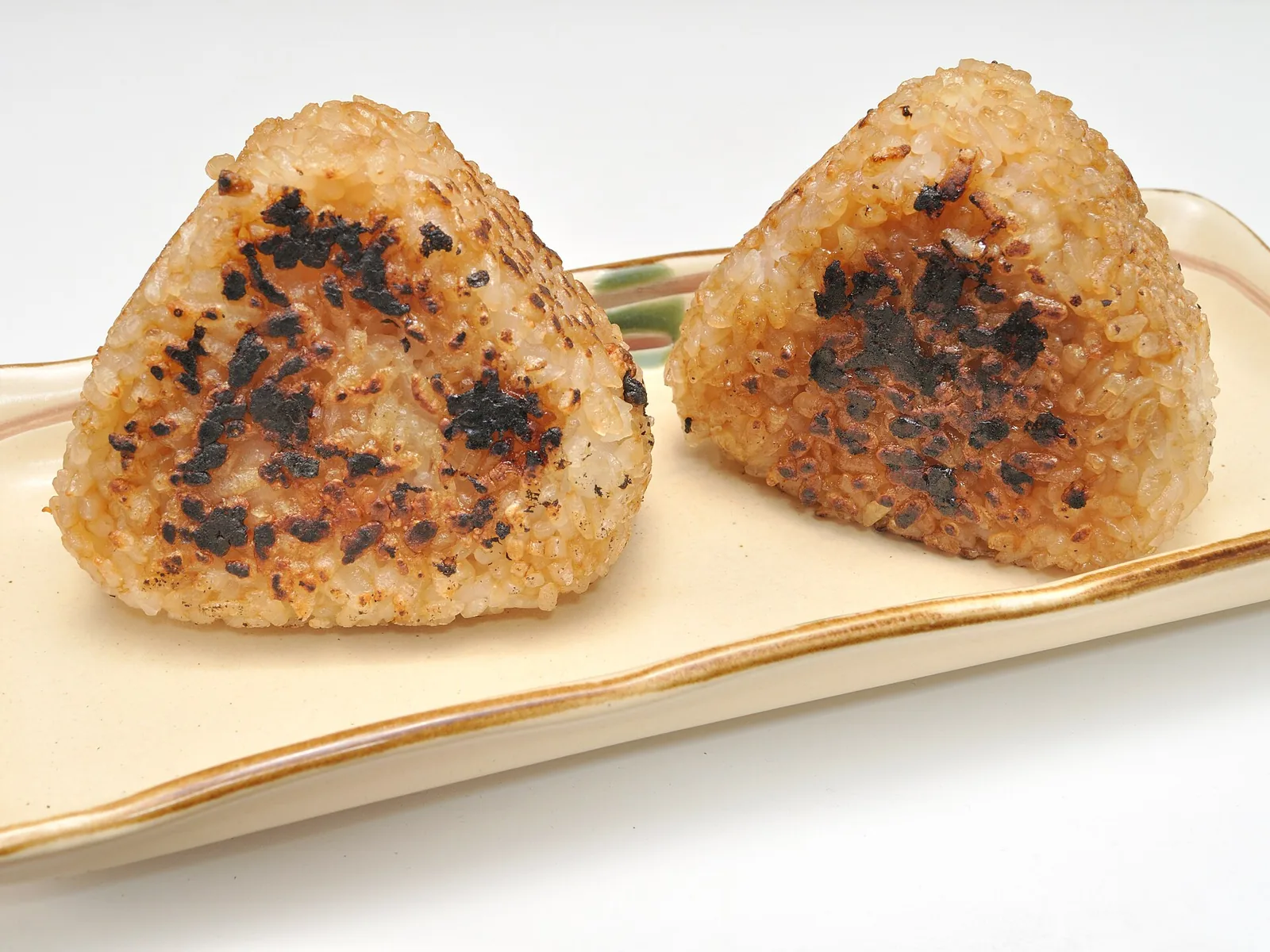
Yaki onigiri (焼きおにぎり) is a rice ball grilled until the outside crusts, brushed with soy sauce or miso partway through so the surface caramelizes and blisters. It is usually made without a filling and without nori, since the point is the crust. Izakaya serve it at the end of a drinking session; it is also the best possible use of yesterday’s rice.
Onigirazu is the modern outlier: rice and fillings layered flat between two nori sheets and cut in half like a sandwich. The name is a joke, meaning roughly “not pressed,” and it came from the manga Cooking Papa in the early 1990s before social media made it a phenomenon. Hawaii contributed its own branch of the family with spam musubi, a block of rice topped with fried Spam and belted with nori.
Two Thousand Years of Rice Balls
In December 1987, excavators at the Sugitani Chanobatake site in what is now Nakanoto, Ishikawa Prefecture, pulled a lump of carbonized rice from a mid-Yayoi layer, roughly two thousand years old. It is often called the oldest onigiri in Japan, though archaeologists think it was steamed in a leaf wrapping, closer to chimaki than to a hand-pressed ball. Nakanoto has claimed the credit anyway. June 18 is Onigiri Day, built from the “6” of the town’s former name, Rokusei, and the 18th of the month, which is already a rice day in Japan.
There is a second, more sober date. January 17 is Omusubi Day, marking the 1995 Great Hanshin-Awaji Earthquake, when volunteers handed out rice balls to people who had lost their kitchens. Onigiri has been Japan’s disaster food ever since, and it is the reason the shelf-stable and instant versions in that market forecast exist at all.
The dish has kept climbing. The Oxford English Dictionary added “onigiri” as an English word in 2024, dedicated onigiri shops now appear in the Michelin Bib Gourmand listings, and Tokyo has a genuine specialist-counter boom underway. Japanese convenience store chains have meanwhile been fighting a price war over the standard rice ball, with some pushing lines back down toward the symbolic 100-yen mark as costs rise.
Practical Notes Before You Buy or Make One
Do not refrigerate onigiri. Below about 4°C, cooked rice retrogrades and turns hard and chalky. Japanese convenience stores hold them in a dedicated warm-cool case for this reason. Eat one within a day, and if you must store it, wrap it tightly and keep it at cool room temperature or freeze it.
Allergens are easy to miss. Soy sauce means soy and, in most brands, wheat. Okaka and any dashi seasoning mean fish. Salmon, tarako and mentaiko are fish. Tuna mayo is fish plus egg. Nori itself is fine for most people, though it is processed alongside seafood. Vegetarians should be aware that a rice ball with no visible fish may still have been seasoned with bonito.
Buying in Japan: the label on the wrapper tells you the filling and the price, and the small numbered tabs tell you the wrapping order. Follow the numbers. Everybody has fumbled one.
An onigiri is rice, salt and hands. It is the least complicated thing in Japanese cooking and one of the hardest to make truly well, which is a fair description of the cuisine as a whole. Start with good short-grain rice, salt your palms, press three times, and eat it warm. For where the rice ball sits in a full Japanese meal, see our guide to the traditional Japanese breakfast.
References
- DataM Intelligence · global instant onigiri market valued at US$1.06 billion in 2025 and projected at US$1.67 billion by 2033
- Nippon.com · onigiri’s history, the Sugitani Chanobatake find, regional shapes, and its Oxford English Dictionary entry
- Nippon.com · how the convenience store rice ball took over, including the separated-nori wrapper
- Just One Cookbook · onigiri technique: salted hands, rice temperature, and how firmly to press
- Just One Cookbook · yaki onigiri, the grilled rice ball and its soy or miso glaze
- Japan Rice · the history of onigiri, its shapes, and the Yayoi-period rice lump behind Onigiri Day
- SoraNews24 · Japanese convenience stores pushing rice ball prices back toward 100 yen
- UNESCO · Washoku, traditional dietary cultures of the Japanese, as Intangible Cultural Heritage
Read Next
- Understanding Japanese Rice And Its Uses
- How To Cook Rice And Why People Wash It Before Cooking
- Sushi vs Sashimi: What Is Sashimi, and What’s the Difference?
- Dried Seaweed (Nori)
- Tsukemono: Japanese Preserved Vegetables
- Spam Musubi: One Of The Most Popular Hawaiian Dishes
- Japanese Breakfast (Asagohan): The Complete Guide to a Traditional Morning Meal
Feature photo by Markus Winkler on Pexels.