Sanma: Why Japan's Autumn Saury Became a Luxury Fish
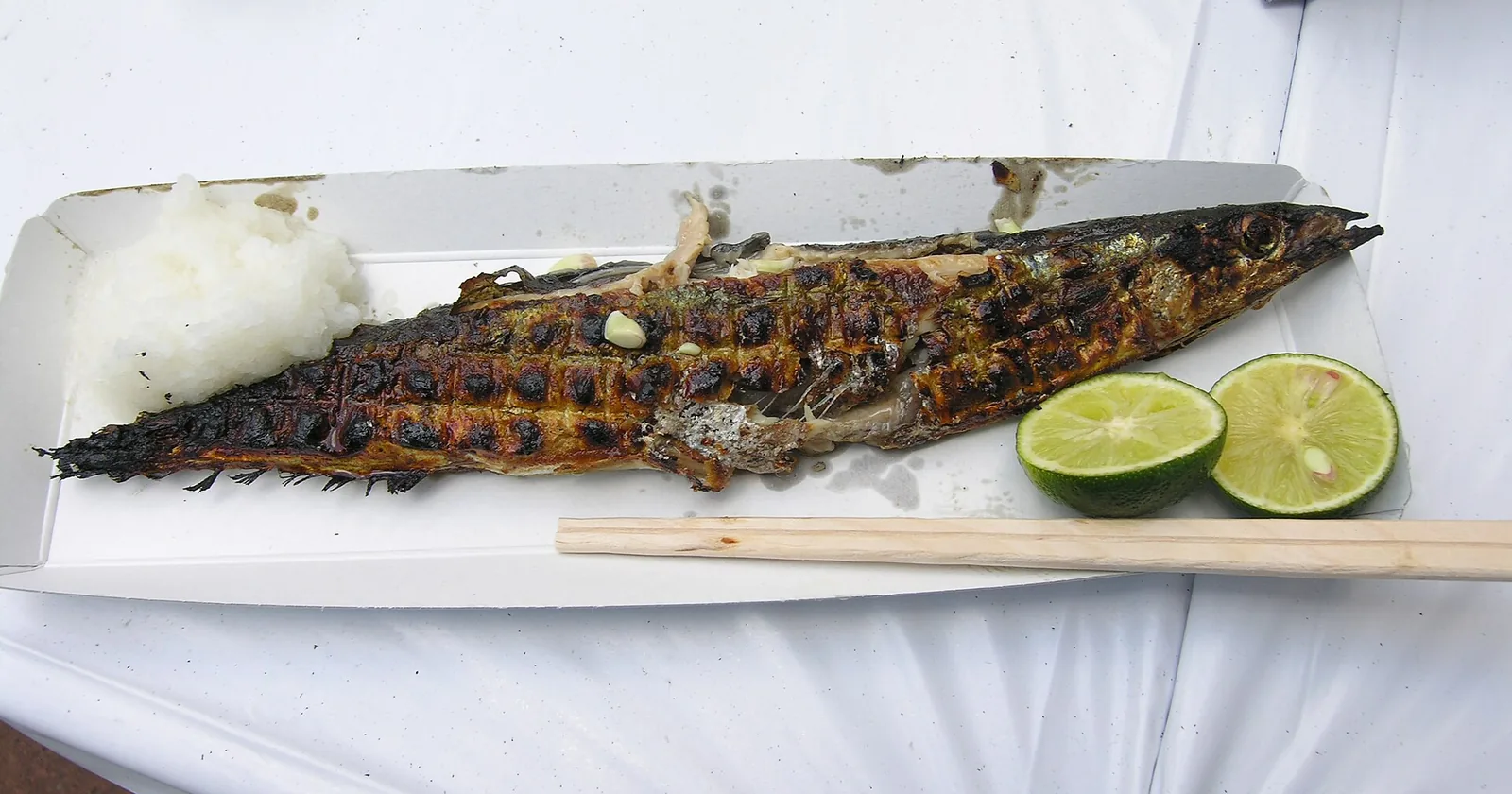
On the morning of 10 July 2026, the first saury of the season went under the hammer at Tokyo’s Toyosu market and set a record. The best of them fetched 700,000 yen per kilogram, beating the previous high of 500,000 yen set two years earlier. The whole first batch weighed about 30 kilograms, landed the day before at Kushiro Port in Hokkaido, and the biggest individual fish, just under 170 grams, sold for around 120,000 yen. One fish. Roughly the price of a good used bicycle.
There is a reason that number made the news in Japan and nowhere else. Sanma is not tuna. It is not a prestige fish and it never has been. It is the cheap, oily, bony thing that Japanese households grilled on autumn evenings because it was the cheap, oily, bony thing, at something like 100 yen apiece, and because for a few weeks a year it happens to be one of the most delicious fish in the sea. Watching it turn into a luxury item is a bit like watching the price of a potato go to the moon. This is what sanma is, how to cook it properly, and what actually happened to it.
The Fish With Autumn in Its Name
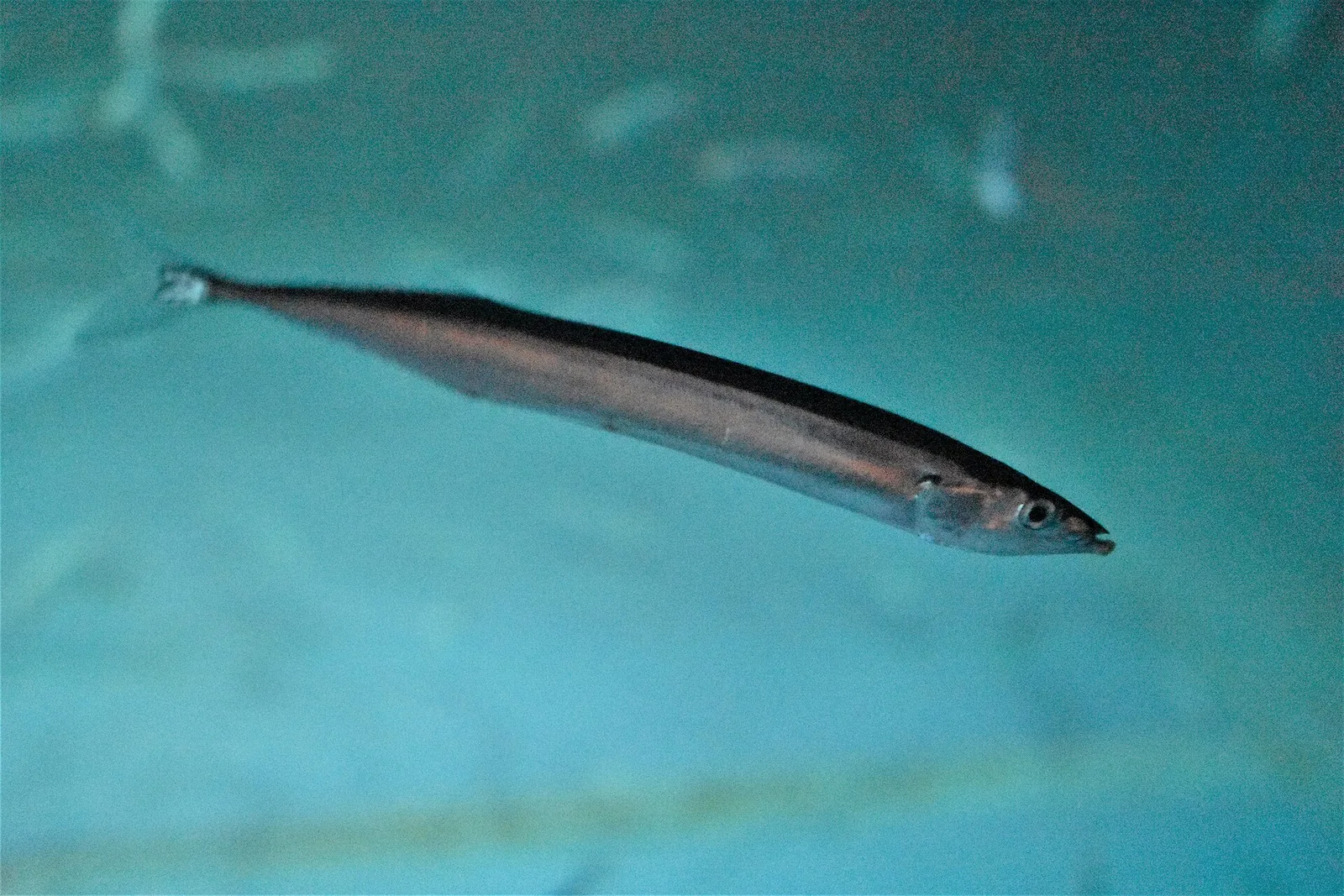
Sanma is Pacific saury, Cololabis saira, a slim silver fish about 30 centimetres long with a pointed lower jaw and a body shaped almost exactly like a blade. Japanese writes it 秋刀魚, three characters that read literally as “autumn sword fish,” and the name is doing real work. The species is inseparable from the season in a way few foods are. Ask a Japanese person what autumn tastes like and there is a decent chance the answer is grilled sanma and smoke.
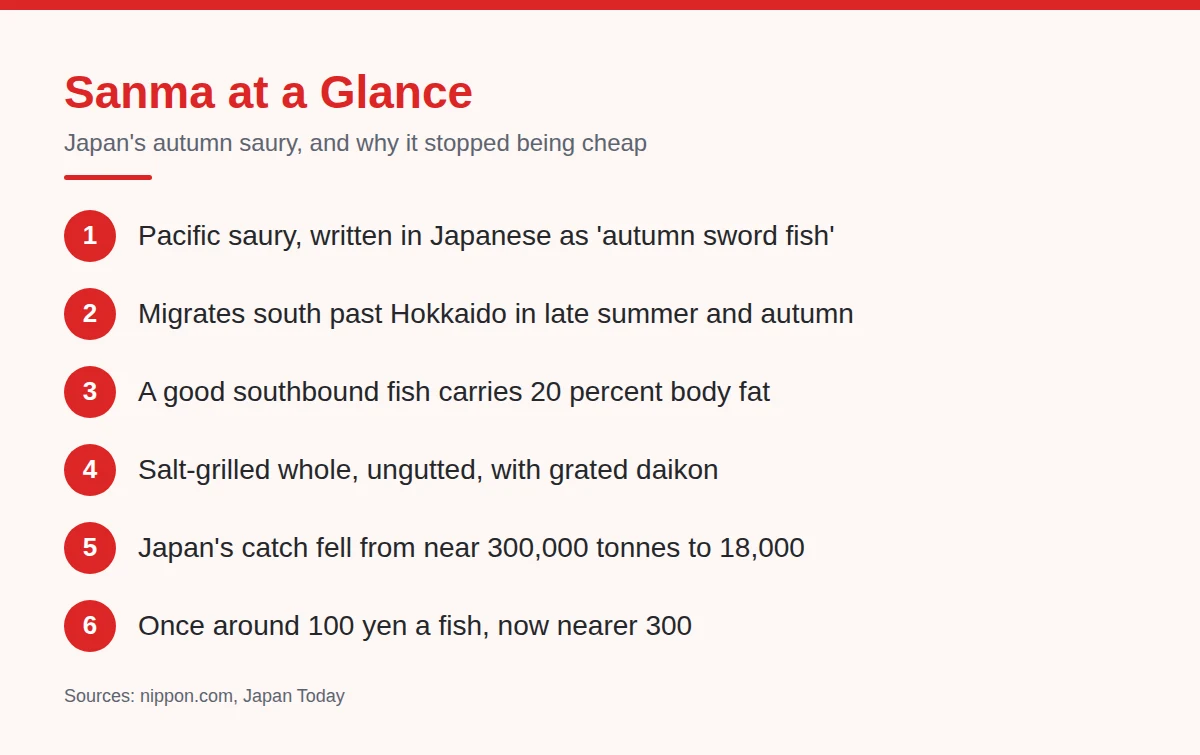
The fish spends most of the year in the cold open North Pacific, then migrates south along the Kuril chain and down the Pacific coast of Hokkaido and the Sanriku shore in late summer and autumn, fattening as it goes. The southbound fish are the prize. By the time they reach the fishing grounds off Hokkaido they can carry 20 percent body fat or more, which is why a good one drips into the fire and comes off the grill with crisp skin over soft, oily flesh. A spring sanma is a different and much duller fish.
Why That Auction Price Is Not the Real Price
Before anyone panics: 120,000 yen is not what sanma costs. Japan has a long habit of paying ceremonial money for the first catch of anything, the same ritual that produces those eye-watering New Year tuna headlines from Toyosu. The buyer gets publicity, the fishermen get a good story, and the price has almost nothing to do with supply and demand. Weeks later the same species is in the supermarket at a normal number.
What makes the 2026 figure worth reading is not the headline but the trend underneath it. The ceremonial premium has been climbing because the ordinary price has been climbing too. Landing prices that used to run around 1,000 yen per 10 kilograms have been closer to 6,000 yen in recent seasons. At the fishmonger, a fish that was around 100 yen for most of living memory has been running near 300 yen at the peak of a good season, and considerably more when the season is bad. That is the story. The auction is just the loudest version of it.
What Actually Happened to the Catch
Japan’s sanma fishery did not decline gently. It fell off a shelf.
| Period | Japan’s annual sanma catch |
|---|---|
| 2001 to 2014 | Around 200,000 tonnes almost every year |
| 2008 (peak) | Close to 300,000 tonnes |
| 2015 to 2018 | Around 100,000 tonnes |
| 2019 onward | Below 50,000 tonnes |
| 2022 | About 18,000 tonnes |
Two things are driving it, and they compound each other.
The first is water temperature. Fisheries researchers find sea surface temperature to be the single best predictor of where sanma will be, and the fish concentrate in water around 15 degrees Celsius. As the seas off northern Japan have warmed, the schools have simply stayed further northeast, outside Japan’s exclusive economic zone, where the Japanese coastal fleet cannot reach them without long and expensive voyages.
The second is that other fleets can. Chinese and Taiwanese vessels work those distant grounds hard, and the stock is now managed internationally through the North Pacific Fisheries Commission rather than by Japan alone. Japan cut its own 2025 quota to 95,623 tonnes, the first time it had gone below 100,000 since quotas began in 1997. At the commission’s tenth annual meeting in Osaka in April 2026, the nine members agreed to trim the shared quota by 5 percent from 202,500 tonnes. Japan and South Korea had pushed for 10 percent and were blocked, with Taiwan citing uncertainty in the stock assessment.
The effect at the table is not only scarcity but shrinkage. Recent seasons have produced noticeably thinner, smaller fish, and with sanma the fat is the entire point. A lean sanma is an ordinary fish. A fat one is a reason to look forward to September.
Sanma Shioyaki, the Only Recipe That Matters
There are sanma recipes involving rice, vinegar and simmering sauces, and they are all fine. None of them is the one. Sanma shioyaki, salt-grilled saury, is what the fish exists for, and it is close to the simplest cooking in Japan.
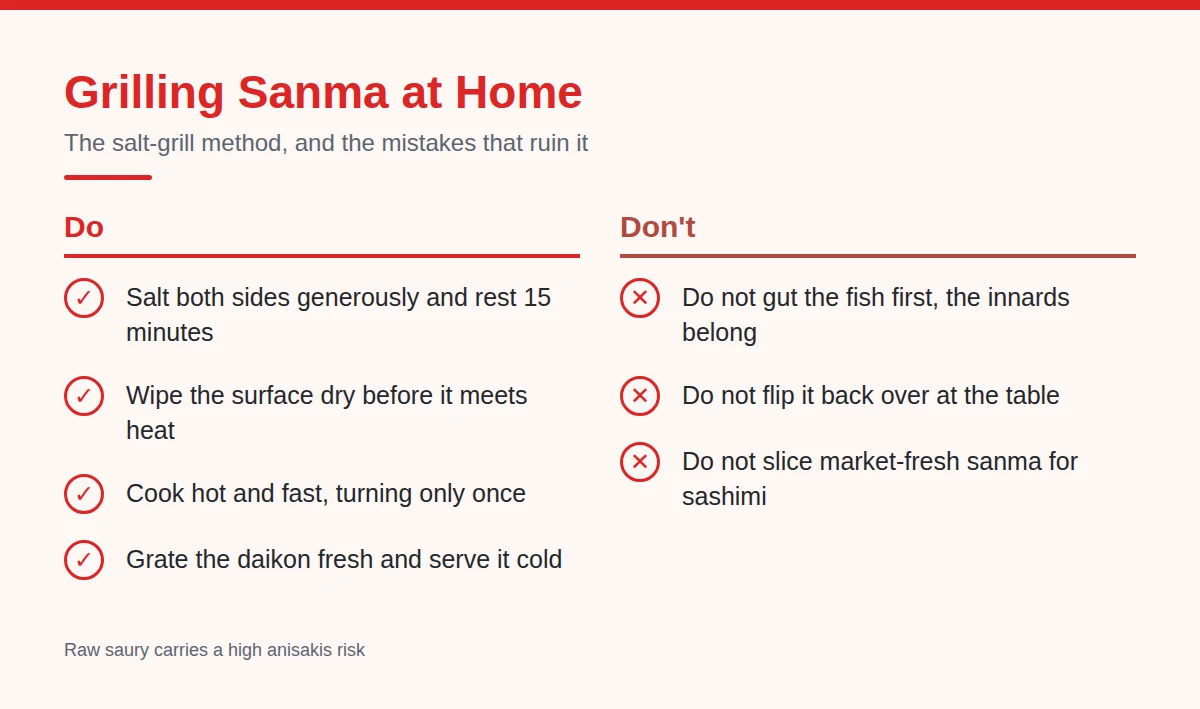
Take a whole fish, ungutted. Rinse it, pat it thoroughly dry, and salt it generously on both sides, a good pinch per side sprinkled from height so it lands evenly. Let it sit 15 to 20 minutes. The salt draws out surface moisture along with some of the fishy smell, and you wipe that moisture off before it goes near heat. This step is what separates a good grilled fish from a steamed, flabby one, and skipping it is the most common mistake.
Then cook it hot and fast, skin close to the heat. A charcoal grill is ideal, an overhead broiler is excellent, a Japanese fish grill or a ridged pan both work. Roughly 5 to 7 minutes a side for a standard fish, until the skin blisters and splits and the flesh at the thickest point flakes. Do not turn it more than once. Two practical notes: a whole sanma is longer than most home broiler pans, so cut it in half crosswise if it does not fit, and the fat will smoke aggressively, so open a window before you start rather than after.
That is the whole technique. No marinade, no oil, no sauce on the fish. Grilled fish this direct sits at the centre of a great deal of everyday Japanese eating, from the dinner table to the traditional Japanese breakfast, where a small grilled fish is the protein next to rice and miso soup.
The Grated Daikon Is Not a Garnish
Every plate of sanma shioyaki arrives with a small heap of grated white radish beside it, usually with a little soy sauce poured over the heap rather than the fish, plus a wedge of sudachi or kabosu citrus. That heap is not decoration and it is not optional.
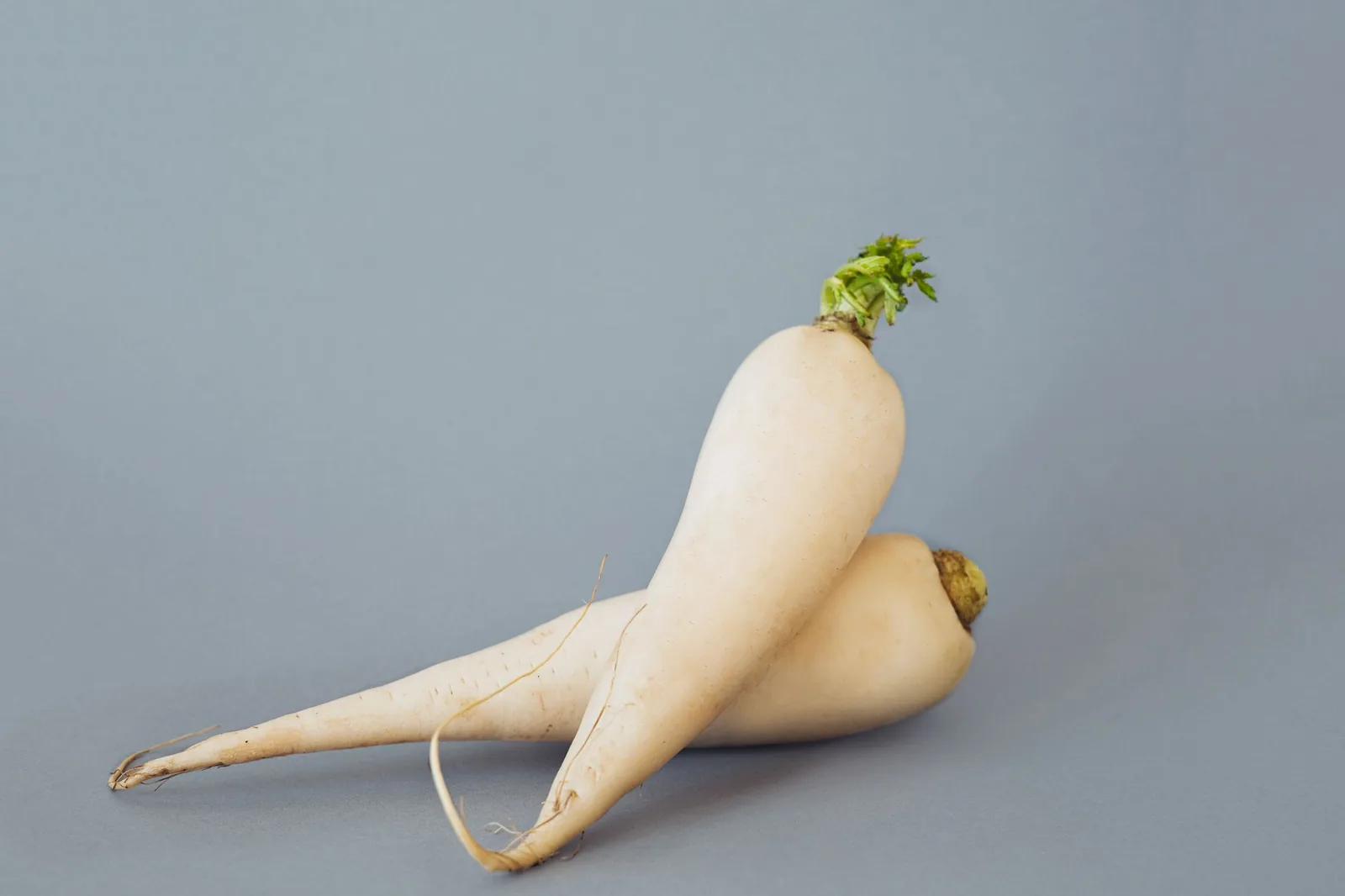
Daikon oroshi does three jobs at once. It is cold, wet and sharp against a fish that is hot, rich and salty, which resets the palate between bites. Its faint peppery bite plays directly against the bitterness of the innards. And the citrus squeezed over the fish cuts through the fat in a way lemon does, only with more floral aromatics behind it. Grate the daikon fresh, from the sweeter upper half of the root nearer the leaves, and let it drain briefly so it is damp rather than soupy. Daikon turns up all over Japanese cooking in exactly this supporting role, whether grated fresh or as pickled daikon alongside rice.
How to Eat a Whole Sanma
Sanma is served whole, head to the left, belly toward you. That orientation is standard for grilled fish in Japan and it exists so a right-handed eater can work along the fish naturally with chopsticks.
The method is to eat from the head end toward the tail along the upper fillet, taking bite-sized pieces off the top of the spine, then lifting the backbone away in one piece to get at the fillet beneath. You do not flip the fish over. Flipping a grilled fish is considered poor form at a Japanese table, and the spine comes out cleanly enough that you never need to. Small pin bones are part of the deal; work them to the edge of the plate.
Then there is the question of the guts. Sanma has no stomach in the usual sense and passes food through quickly, which is why the innards are eaten rather than discarded. They are intensely bitter, and for many Japanese eaters that bitterness against the fat and the grated daikon is the best part of the fish. It is also the part most first-timers dislike. Eat around it if you want to, but try one bite with a little daikon on top before deciding. If you do eat them, they need to be fully cooked.
Meguro no Sanma: The Joke That Became a Festival
There is a classic rakugo comic story called Meguro no Sanma. An Edo-period lord out hawking in Meguro gets hungry, smells a farmer grilling saury, eats some and thinks it is the best thing he has ever tasted. Back at the residence he asks for sanma. The kitchen is horrified that a lord would eat peasant fish, so they source a proper one from the Nihonbashi market, steam the fat out of it, pick out every bone and serve the sad remains in a soup. The lord takes one taste and asks where the fish came from. Nihonbashi, he is told. “That explains it,” he says. “Sanma must be from Meguro.”
The joke is that Meguro is inland with no ocean anywhere near it. The lord is so insulated from ordinary life that he has mistaken the cooking for the sourcing, and misidentified the geography of his own city.
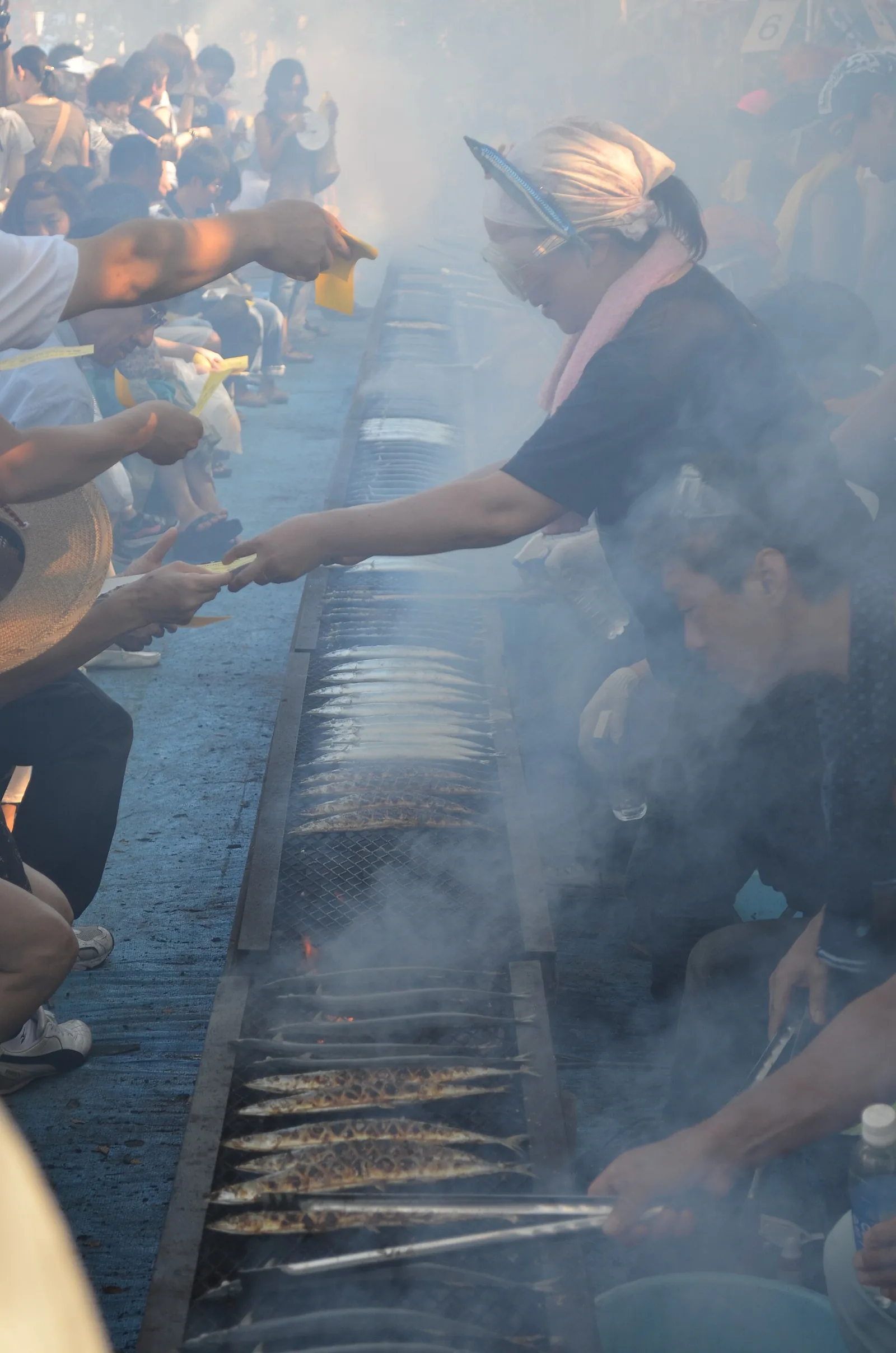
Meguro has leaned into the punchline. The Meguro Sanma Matsuri, held near Meguro Station and scheduled for 6 September in 2026, grills thousands of saury over long charcoal trenches and gives them away free to a queue that forms hours early. The fish come from Miyako in Iwate Prefecture. A separate saury event runs as part of the Meguro Citizens’ Festival in autumn, using fish from Kesennuma in Miyagi, one of Meguro’s sister cities. Both hand out rakugo alongside the fish. It is one of the better examples of what happens when a Japanese festival is built entirely around one ingredient, and it sits neatly beside the other autumn food traditions like tsukimi moon-viewing in September.
Buying Sanma Outside Japan
Japanese and Korean grocers stock frozen sanma through most of the year and sometimes fresh in autumn. Frozen is not a compromise here. Sanma is oily and freezes well, and much of what is sold in Japan outside the peak weeks is frozen too.
Look for a fish with a plump, arched back rather than a straight flat one, since the arch signals fat. The eye should be clear rather than clouded, the skin bright silver and unbroken, the body firm. A pointed yellow tip on the lower jaw is a traditional sign of freshness. Size matters more than usual with this species: anything under about 100 grams is likely to be lean and disappointing, and the fish worth buying tend to run 130 grams and up. Frozen fish should be thawed in the refrigerator overnight, then dried and salted exactly as above.
Allergens and safety. Sanma is finfish and a declared allergen. The soy sauce that goes on the daikon contains soy and, unless it is tamari, wheat. Sanma is an oily fish with the usual omega-3 benefits, and as a small, short-lived species it sits at the low end of the mercury range, unlike the large predators, so it is a reasonable choice during pregnancy when fully cooked.
Raw Sanma and the Anisakis Question
Sanma sashimi exists and is genuinely excellent, but it comes with a real caveat. Pacific saury carries a high prevalence of Anisakis, a parasitic nematode, and is among the species most often implicated in anisakiasis cases in Japan. Infection means sudden violent abdominal pain, nausea and vomiting, sometimes requiring endoscopic removal of the worm.
In Japan, raw sanma is generally a landing-port privilege, eaten within hours of the catch by people who know how to inspect it. Elsewhere, the rule is straightforward: do not make sashimi from a fresh sanma you bought at a market. Japan’s health ministry guidance is to freeze at minus 20 degrees Celsius for at least 24 hours to kill the parasite, and commercially frozen-at-sea fish has typically already met a comparable standard. Wasabi, soy sauce and vinegar do not kill Anisakis, whatever you may have been told. If you want to understand where sanma fits among raw preparations generally, our guide to sashimi and its types covers the wider category.
What It Means When a Cheap Fish Gets Expensive
The thing worth sitting with about sanma is not the record auction price. It is that Japan is losing a food that was defined by being ordinary. Sanma was never special-occasion eating. It was the fish that told you the season had turned, affordable enough that everyone ate it and smoky enough that whole neighbourhoods smelled of it in September.
A fish at 300 yen instead of 100 is still affordable. But the shape of the thing has changed, and the shrinking bodies suggest the trend has further to run. If you can get a good fat one this autumn, salt it hard, grill it hot, grate the daikon fresh, and take the twenty minutes. That is the whole argument for seasonal eating, compressed into one very bony fish.
References
- Jiji Press via nippon.com · the season’s first saury fetching a record 700,000 yen per kilogram at Toyosu
- nippon.com · long-run catch tonnage, landing prices and the sub-100,000-tonne 2025 quota
- Japan Today · the North Pacific Fisheries Commission’s 5 percent cut to the 2026 saury quota
- SeafoodSource · sea surface temperature as the main predictor of saury distribution and the EEZ problem
- Just One Cookbook · the salting and grilling method for sanma shioyaki
- Tokyo Multicultural Portal · the rakugo origins of the Meguro Saury Festival
- Tokyo Cheapo · Meguro Sanma Matsuri dates and the Miyako and Kesennuma fish
- Tokyo Weekender · anisakiasis in Japan and the ministry freezing guidance
Read Next
- Toyosu Fish Market: What You Should Know
- Understanding Hokkaido and Its Specialty Foods
- Japanese Breakfast (Asagohan): A Traditional Morning Meal
- How to Make Japanese Style Pickled Daikon
- What Is Sashimi and the Different Types
- Tsukimi Food: What Japan Eats for Moon-Viewing
Feature photo by Paul Hsu from Tokyo, CC BY 2.0, via Wikimedia Commons.